

England’s local government reorganisation reset: what has happened, what is still going ahead and what comes next
Current to 13 September 2026
For almost two years, councils across much of England have been working towards the largest restructuring of local government in a generation. Proposals have been prepared, consultations completed, boundaries drawn, implementation teams assembled and millions of pounds committed.

On 7 September 2026, however, the Government fundamentally reset the programme. The decisions previously announced for Essex, Hampshire and the Solent, Norfolk and Suffolk have been withdrawn. Decisions covering a further 14 areas have been paused and placed under review. Cambridgeshire and Peterborough and West Sussex, where decisions had not yet been made, have also been brought into the review. Only Surrey remains on its existing statutory path. Elections scheduled for May 2027 in the reviewed areas will now take place for the existing councils on existing boundaries, not for new shadow unitary authorities. The Government has nevertheless insisted that LGR has not been abandoned.
The central message is therefore more complicated than either “LGR has been cancelled” or “nothing has changed”.
Outside Surrey, the structures announced in March and July 2026 can no longer be treated as settled implementation plans. But the Government’s stated policy remains to replace England’s remaining two-tier arrangements with unitary local government.
What exactly changed on 7 September?
The Secretary of State, Angela Rayner, said the Government had received “updated and privileged legal advice”. She wanted reassurance that the process was lawful and robust and that the proposals were consistent with the priorities of the new administration and its wider plan for “rewiring the state”. Government lawyers notified the courts that the four March decisions had been withdrawn.

There are important legal distinctions:
Withdrawn means the March decisions for Essex, Hampshire, Norfolk and Suffolk no longer stand. It does not prevent ministers from making new decisions after reconsideration.
Paused and under review means the 14 choices announced on 16 July have not been formally withdrawn, but councils have been told to stop implementing them.
Awaiting decision applies to Cambridgeshire and Peterborough and West Sussex. Their expected October decisions are no longer expected separately; they will be considered with the review.
Legally established applies only to Surrey. Its Structural Changes Order has been approved, the new councils exist in shadow form and elections have taken place.
Ministers have asked councils outside Surrey to cease work specifically directed at implementing the previous decisions. However, work that would be useful under different future configurations can continue: improving data quality, mapping services, finances, contracts, assets and workforces, identifying risks, undertaking digital discovery and engaging partners.
The following diagram illustrates the four different positions created by the September reset.
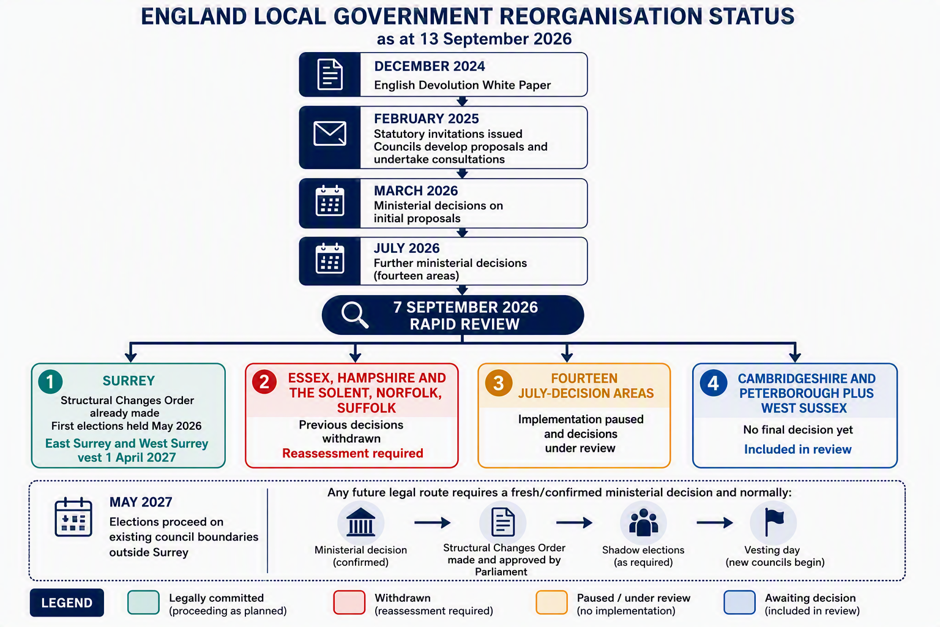
Figure 1: The 7 September 2026 announcement did not cancel LGR everywhere: it left Surrey on a statutory path to April 2027, withdrew four earlier decisions, paused fourteen, and brought two undecided areas into the review.
Where every area now stands
The table uses the Government’s terminology rather than implying that a proposal has been cancelled where ministers have only paused or withdrawn a previous decision. The configurations shown are what had been selected before 7 September; they are not current guarantees.
Area | Position immediately before 7 September | Position at 13 September 2026 |
Surrey | Two councils: East Surrey and West Surrey | Proceeding in law. Elections held May 2026; vesting 1 April 2027 |
Essex, Southend-on-Sea and Thurrock | Five-unitary model selected in March | Decision withdrawn; included in review |
Hampshire, Isle of Wight, Portsmouth and Southampton | Four new mainland councils; Isle of Wight continuing separately | Decision withdrawn; included in review |
Norfolk | Three unitaries: Greater Norwich, East Norfolk and West Norfolk | Decision withdrawn; included in review |
Suffolk | Three-unitary model | Decision withdrawn; included in review |
Derbyshire and Derby | Two-unitary model | Decision paused and under review |
Devon, Plymouth and Torbay | Four-unitary model, including expanded Exeter, Plymouth and Torbay | Decision paused and under review |
East Sussex and Brighton and Hove | East Sussex plus an expanded Brighton and Hove | Decision paused and under review |
Gloucestershire | One countywide unitary | Decision paused and under review |
Hertfordshire | Four-unitary model | Decision paused and under review |
Kent and Medway | Four-unitary model | Decision paused and under review |
Lancashire, Blackpool and Blackburn with Darwen | Four-unitary model | Decision paused and under review |
Leicestershire, Leicester and Rutland | Expanded Leicester plus Leicestershire and Rutland | Decision paused and under review |
Lincolnshire, North Lincolnshire and North East Lincolnshire | Four-unitary configuration | Decision paused and under review |
Nottinghamshire and Nottingham | Two-unitary model, including an expanded Nottingham | Decision paused and under review |
Oxfordshire and West Berkshire | Three unitaries, including Ridgeway incorporating West Berkshire | Decision paused and under review |
Staffordshire and Stoke-on-Trent | Two-unitary model | Decision paused and under review |
Warwickshire | Two-unitary model | Decision paused and under review |
Worcestershire | Two-unitary model | Decision paused and under review |
Cambridgeshire and Peterborough | No decision had been announced | Outstanding and included in review |
West Sussex | No final decision had been announced | Outstanding and included in review |
Several July choices involved more than merging complete districts. The former Secretary of State selected expanded city footprints around Exeter, Plymouth, Leicester, Nottingham, Oxford and Brighton and Hove. West Berkshire was brought into the Oxfordshire configuration despite not having received the original statutory invitation. Those boundary modifications were among the most politically and legally contested elements of the programme.

How England arrived here
The policy began with the English Devolution White Paper on 16 December 2024. It argued that strong unitary councils should form the foundations of mayoral strategic authorities. The proposal had not appeared in Labour’s 2024 general election manifesto.
On 5 February 2025, ministers formally invited councils in two-tier areas and neighbouring smaller unitaries to submit proposals. Interim plans were required by 21 March. Surrey submitted final proposals in May; the Devolution Priority Programme areas submitted in September; the remaining areas submitted by 28 November 2025. Despite encouragement to agree locally, every area produced competing options: 69 proposals were received in total.
The assessment criteria required proposals to:
establish a single tier across the area;
create councils of sufficient scale, capacity and financial resilience;
protect sustainable public services;
demonstrate collaboration and engagement;
support devolution; and
strengthen community and neighbourhood involvement.
A population of 500,000 or more was described as a “guiding principle”, not a binding minimum. Ministers repeatedly said smaller councils could be accepted where geography, identity, public services, growth or devolution provided a convincing justification. The decisions eventually announced included numerous proposed authorities below 300,000 residents.
The Government’s original sequence was:
Surrey shadow elections in May 2026 and vesting on 1 April 2027;
decisions elsewhere during 2026;
shadow elections on 6 May 2027;
vesting on 1 April 2028.
That timetable is now valid only for Surrey.
Why did ministers pursue LGR?
The Government’s case rested on four connected arguments.
Simpler accountability
In a two-tier area, counties typically provide social care, children’s services, education, highways and waste disposal, while districts provide planning, housing, waste collection, environmental health, leisure and revenues and benefits. Ministers argued this division confuses residents, fragments accountability and produces duplication. Around 20 million people, nearly one-third of England’s population, live in two-tier areas.
Financial efficiency
The Government argued that combining management, democratic, property, ICT, procurement and support functions could reduce overheads and release money for services. However, its national savings claim relied heavily on modelling commissioned by the County Councils Network rather than a new government-wide costed implementation plan.
Service integration
Unitary councils can place responsibilities such as housing, homelessness, public health and social care within one organisation. In principle this can support prevention and make partnership working easier. But where one county service must be divided among several new councils, LGR can also introduce fragmentation that does not currently exist.
Devolution and growth
The Government saw unitaries as stronger constituent authorities for mayoral strategic authorities. Some selected boundaries deliberately expanded cities whose administrative areas were judged too constrained to plan housing, transport and economic growth effectively. The July decisions specifically referenced Plymouth, Leicester, Preston, Derby, Nottingham, Exeter, Oxford, Brighton and Lincoln.
Why has the programme now been interrupted?
The official explanation: legality and a change of administration
The precise legal advice remains privileged and has not been published. Ministers have said there has been no court judgment finding the programme unlawful and that the statutory powers themselves remain valid. The review will nevertheless reconsider the criteria, decision-making process and the relationship between LGR and the new Government’s wider state-reform programme.
Boundary changes created legal exposure
Under the Local Government and Public Involvement in Health Act 2007, ministers may invite proposals, consult and make Structural Changes Orders. Several legal challenges questioned whether extensive boundary alterations, including splitting existing districts, could lawfully be delivered by modifying submitted proposals rather than using separate boundary procedures.
Decisions were disputed on financial and evidential grounds
In Essex, government officials reportedly recommended three councils, while ministers chose five. Hampshire County Council argued that the selected five-authority configuration would add £31 million a year, while the councils supporting it projected £63.9 million of annual savings and a roughly three-year payback. The fact that two public bodies could reach conclusions almost £95 million apart illustrates how profoundly assumptions about disaggregation, transformation and workforce design influenced the numbers.
Capacity and timetable risk were escalating
Councils were being asked simultaneously to maintain statutory services, run elections, design shadow authorities, split county services, combine district services and support new devolution arrangements. The LGA had already warned that parallel devolution and reorganisation would stretch capacity. After the pause, it said councils had invested scarce resources and “countless hours” and called for a clear timetable and protection from additional costs. Significantly, the LGA statement recorded that consensus had not been reached across its political leadership.
The financial evidence: savings are possible, but not automatic
The strongest national comparison is PwC’s 2025 update covering England’s 21 two-tier county areas. It modelled markedly different financial outcomes depending on how many unitary councils were created in each county.
National model | Estimated one-off cost | Estimated recurring annual saving | Estimated five-year net position |
One unitary per county area | £425m | £693m | £2.87bn net saving |
Two unitaries per county area | £562m | £282m | £707m net saving |
Three unitaries per county area | £700m | £17m | Marginal annual saving before recovering transition cost |
The central reason is disaggregation. Moving district services upwards creates consolidation savings; splitting social care, highways, education, finance systems, contracts and specialist workforces downwards adds duplicated capacity and transition costs. PwC’s results are modelling, not audited future outcomes, and do not prove that one countywide council is automatically the best structure for every place.

Across the actual proposals submitted to government, LGIU calculated an average estimated transition cost of £54.8 million, average recurring annual savings of £42 million, an average proposed unitary population of 515,430, and an average 55.2% reduction in councillor numbers. Annual savings claims ranged from about £19 million to more than £100 million, reflecting very different assumptions and definitions.
What local business cases show
Area and model | Published financial projection | Evidence caution |
Surrey: two unitaries | Updated implementation estimate of £93.5m: £35.3m before vesting and £58.2m afterwards, including £37.6m for ICT and £11.8m for redundancy and early retirement | Surrey is proceeding, but savings still depend on later integration and transformation |
Norfolk: three unitaries | £96m one-off investment, £6m recurring additional cost, £56m recurring gross savings and about £49m annual net benefit from 2033/34; claimed payback in year four | Model incorporated ambitious prevention and service-redesign benefits; the decision has been withdrawn |
Greater Essex: five unitaries | £73.9m one-off cost and claimed future annual net benefit of £104.3m | Much of the projected benefit arose from social-care transformation and demand reduction, not merely abolishing councils; the decision has been withdrawn |
Hampshire: five-unitary configuration | Supporting councils claimed at least £63.9m annual recurring savings and three-year payback | Hampshire County Council disputed the methodology and claimed the model would add £31m annually |
These cases are not directly comparable. Some count only structural savings; others include digital transformation, procurement, prevention, social-care demand management, estates rationalisation or additional income. Some report gross savings before recurring costs, others net benefits. Longer forecasting periods naturally produce larger cumulative totals.
History also advises caution. Grant Thornton’s review of recent unitaries found that benefits commonly emerged 12–18 months after vesting or later, rather than immediately. Its August 2026 analysis identified planned savings requirements of £49 million in Norfolk, £61.3 million in Suffolk, £87.7 million in Greater Essex and £55.6 million in Hampshire and the Solent before LGR benefits were taken into account. Those underlying pressures would transfer to successor councils rather than disappear.
Government support is small relative to total implementation costs
The Government initially provided £7.6 million for proposal development and later announced £63 million of capacity funding. The July package included £900,000 per proposed new unitary, up to £150,000 for leadership continuity in children’s services, adult social care and public health, and up to £1 million nationally for complex fire transitions.

Even “more than £1 million per new unitary” covers only a fraction of business-case implementation estimates commonly running into tens of millions. Ministers said on 7 September that funding would be considered during the review. No general compensation settlement for abortive expenditure had been announced by 13 September. East Hampshire alone reported £295,000 of direct LGR spending over 18 months, excluding diverted staff time, and requested reimbursement.
Debt further complicates the picture. Government committed in principle to repay £500 million of Woking’s debt before West Surrey vests and announced £200 million of support for Thurrock. Such interventions are exceptional: other new authorities cannot assume historic borrowing will be written off.
What does the pause mean in practice?
Services and residents
Existing councils remain legally responsible for services until abolished by an approved Structural Changes Order and the arrival of vesting day. Outside Surrey, no such replacement is currently imminent. Waste collections, planning decisions, social care, schools, highways, benefits and housing functions therefore continue through existing councils.
Workforce and leadership
The pause reduces the immediate pressure to recruit entire shadow structures, but prolongs uncertainty. Staff may not know which organisation, geography or leadership team they could eventually join. Previous reorganisation experience identifies retention risk, loss of senior expertise, competition for scarce finance, digital, legal and social-care skills, and pressure on employees simultaneously delivering business-as-usual services and transformation.
Contracts, technology and data
Councils can continue “no-regrets” work such as contract registers, data cleansing and system discovery. They should not, however, commit to a technology architecture, procurement, property disposal or workforce structure designed solely around a configuration that may change. Surrey’s implementation plan alone illustrates the scale of work: disaggregating county services, aggregating district functions, transferring data and staff, establishing governance and keeping services safe and legal.
Democracy
May 2027 elections will proceed on existing boundaries. Some councillors elected then could serve shortened terms if shadow elections follow in 2028, but the Government has not confirmed their eventual term lengths. Ministers indicated that shadow elections in 2028 are an anticipated possibility, not a settled national timetable.
LGR and devolution are related, but they are not the same
LGR determines which councils deliver local government services. Devolution transfers powers and funding from Whitehall to strategic authorities, often led by mayors. A mayoral authority does not normally collect bins, determine routine planning applications or manage individual social-care cases; constituent councils continue those functions.
The September pause does not formally pause devolution. The Government still intends every part of England to have, or be establishing, a strategic authority by the end of 2027 and to have full coverage by the end of 2028. Mayoral elections are currently scheduled for May 2027 in Cumbria and Cheshire and Warrington, and May 2028 in Norfolk and Suffolk, Greater Essex, Sussex and Brighton, and Hampshire and the Solent.
However, there is a practical dependency. Strategic authorities need stable constituent councils, agreed membership and sufficient capacity. If the unitary map changes, representation, voting arrangements, financial contributions and delivery capacity may require revision. Conversely, ministers have confirmed that work on devolution and strategic spatial planning can continue while LGR is reviewed.

What can now be said with confidence?
Confirmed
East Surrey and West Surrey will vest on 1 April 2027.
The other four March decisions have been withdrawn.
Fourteen July decisions are paused and under review.
Cambridgeshire and Peterborough and West Sussex remain undecided.
May 2027 elections outside Surrey will take place for existing councils.
Existing councils continue providing services.
The Government remains publicly committed to LGR and devolution.
Not confirmed
Whether the withdrawn or paused configurations will ultimately be restored.
Whether ministers will adopt different numbers of unitaries or boundaries.
Whether the review will require renewed statutory consultation.
When new Structural Changes Orders will be laid.
Whether shadow elections will be held in May 2028.
Whether vesting outside Surrey will move to April 2029.
How councils will be compensated for abortive work or additional elections.
Whether the £63 million support package will be redistributed.
Lancashire County Council has suggested that, if shadow elections occur in 2028, April 2029 would be the likely vesting date. That is a reasonable local planning assumption, but it is not yet a national government decision.
What should readers watch next?
The rapid review’s terms and conclusions. Ministers described the ambition as “weeks rather than months” and promised an update at the earliest opportunity, but no formal completion date had been published by 13 September.
The autumn Rewiring the State White Paper. It is expected to contain an implementation timetable, public-service boundary proposals and further detail on local financial sustainability and fiscal devolution.
Fresh or reaffirmed ministerial decisions. The critical question will be whether existing configurations are retained, modified or replaced.
Statutory consultation. Substantially altered proposals may require additional consultation before implementation.
Structural Changes Orders. No reviewed area can move securely to shadow authorities and vesting without the necessary secondary legislation and parliamentary approval.
Election legislation and guidance. May 2027 is now settled for existing councils, but the timing and electoral arrangements for successor councils remain open.
Resolution of litigation and legal costs. The withdrawal of four decisions changes the live court position, but costs will be determined through the usual legal process.
Compensation and capacity funding. Councils will expect clarity on sunk costs, ongoing programme teams and whether “no-regrets” work remains grant funded.
Surrey’s delivery. Surrey is now the live test of whether two new councils can manage workforce transfer, ICT integration, debt, council-tax harmonisation and safe service continuity within the published timetable.

The truth at the centre of the issue
There is a credible case that simpler structures can reduce duplication, clarify accountability and create opportunities to integrate services. Previous reorganisations and national modelling show that recurring savings are possible.
But structural change is not itself service transformation, and a projected saving is not cash until posts, buildings, systems, contracts and operating models actually change. The more a proposal divides established county services, the greater its implementation and financial risk. The more it centralises into very large councils, the greater the concern about local identity, representation and responsiveness.
The September decision is therefore neither the end of English LGR nor a minor administrative pause. It is a substantial national reset caused by legal uncertainty, a change in government priorities, disputed evidence and mounting delivery risk. Surrey continues. Everywhere else must wait for a new, legally robust and politically sustainable decision.
Until that decision is made, the responsible position for councils is equally clear: protect today’s services, retain essential capacity, continue genuinely configuration-neutral preparation, avoid irreversible commitments and be honest with residents and staff about what is, and is not, known.


