

The Golden Thread: Building a Whole-Life Evidence System for Prevention
The deepest weakness in public-service planning is not that councils lack information. It is that they hold fragments of a life: a child-protection episode in one system, school absence in another, homelessness in a third, adult social-care support elsewhere and NHS activity beyond the council boundary.
A “golden thread” should not mean predicting that a child who receives social care will later become homeless, unwell or dependent on adult services. That would be both analytically unsound and ethically dangerous. It should mean creating sufficient longitudinal visibility to ask better questions: which childhood experiences, interventions and transitions are associated with better outcomes; what appears to prevent escalation; for whom; and where are costs displaced between organisations?
The strongest evidence suggests two distinct propositions:
Joined-up family interventions can improve outcomes and avoid substantial near-term costs. Supporting Families and Family Safeguarding provide the clearest English evidence.
Linked population data can reveal service pathways that no single organisation can see. Bristol, Bradford, Kent, Greater Manchester, Barking and Dagenham, BOLD and emerging national adult-social-care data demonstrate this capability.

What has not yet been demonstrated robustly is that a particular childhood intervention produces a quantified reduction in adult-social-care expenditure twenty years later. The argument for longitudinal infrastructure is therefore not that the savings are already proved. It is that without the infrastructure, they may never be provable.
An evidence ladder: do not mistake technology for impact
A council should assess maturity at four separate levels:
Linkage capability: records can be matched accurately across time, people, families and households.
Operational use: practitioners or commissioners routinely use the resulting information.
Population insight: linked data changes understanding of pathways, inequalities, demand or priorities.
Demonstrated return: a credible counterfactual shows improved outcomes, cashable savings or avoided costs.
Many initiatives reach levels one and three but not two or four. A sophisticated data platform is not itself prevention; a dashboard is not an outcome; and a modelled benefit is not necessarily a budget reduction.
Comparative evidence
Model | What is linked and how used | Evidence maturity | Outcomes or savings position | Most transferable lesson |
Supporting Families | Local family-level services plus nationally linked DfE, DWP and MoJ records; impact and cost-benefit evaluation | 4 | At two years: 32% lower likelihood of children being looked after, 35% lower juvenile custody, 25% lower adult custody; £2.28 economic and £1.51 financial benefit per £1 spent | Build evaluation and linkage into the programme from inception, not afterwards |
Bristol Think Family Database | Around 55,000 families; children’s social care, early help, education, housing, youth justice, police, DWP, NHS and voluntary-sector data | 2–3 | Independent evaluation reported a fuller vulnerability view, significant practitioner time savings and timelier support; no published cashable saving | Combine the analytical asset with applications, alerts, training and professional judgement |
Connected Bradford | Health, education, social care, environmental and other council data; over 40 years for 800,000 people | 3 | Major research and population-health capability; no single platform-level ROI claim | A durable population spine, public engagement and policy integration matter as much as technology |
Kent Integrated Dataset | GP, acute, community, mental-health, public-health and adult-social-care activity, costs and deprivation | 3 | Supports pathway analysis, commissioning and economic modelling; children’s social care was a known gap in the published resource | Include episode-level cost from the start, but do not call a health-and-adult-care dataset a whole-life record |
Care City Cohort, Barking and Dagenham | Individual and household-linked health, adult-social-care, tenure, deprivation and service-use data from 2011 | 3 | Used for vaccination inequality, care-home GP coverage and discharge/domiciliary-care analysis; no published cashable return | UPRN-based household analysis reveals needs invisible in person-only records |
Greater Manchester | GM Care Record, local-authority social care, health feeds, analytics platform and secure data environment | 2–3 | Strong operational and analytical architecture; GM’s CBA model tracks fiscal, economic and social value, but the platform itself should not be credited with savings | Use one governance framework while separating direct care from secondary analytics |
BOLD homelessness–justice linkage | H-CLIC linked to prison, probation and offender-assessment systems using probabilistic linkage | 3 | 7,116 linked people; homelessness outcomes were associated with later justice-system contact, but the study explicitly does not establish causality | National linkage can expose transition failures and missing information at local front doors |
Adult Social Care Client Level Data | Quarterly event-level council data, NHS-number tracing and potential linkage to pseudonymised NHS records | 1–3, emerging | Replaces aggregate SALT reporting and enables pathway analysis; outcome and financial-return evidence is still developing | English councils now have a common adult-care event model on which local longitudinal work can build |
Camden Residents Index | Probabilistic matching across council systems, using UPRN for person, household and place views | 2–4 in defined uses | Identified 23 high-risk illegal-subletting cases; each recovered property was estimated to avoid £18,000 annually | A resident index can deliver early value through data quality, fraud and operations before more complex prevention uses |
Family Safeguarding | Multidisciplinary children’s and adult-service practice supported by an electronic family workbook | 4 for intervention evidence | Reductions in care entry, child-protection plans and police call-outs; modelled break-even from 8 to 56 months across five councils | Data creates value when attached to an integrated operating model, not when left with analysts |
What the strongest English evidence actually tells us
Supporting Families: the national proof of concept
Supporting Families remains the most persuasive demonstration that local family work can be assessed across institutional boundaries. Its evaluation linked administrative records for more than one million individuals across DfE, DWP and MoJ. Families receiving support were compared with families on a waiting list, while propensity-score matching adjusted for observable differences between programme and comparison groups.
At two years, the evaluation reported a 32% reduction in the likelihood of a child being looked after, 35% lower juvenile custody, 15% fewer juvenile convictions, 25% lower adult custody and a 10% reduction in adults claiming Jobseeker’s Allowance. The cost-benefit analysis reported £2.28 of economic benefit and £1.51 of financial benefit for every £1 spent.
This remains quasi-experimental rather than randomised. Propensity matching cannot eliminate unobserved differences, and the national evaluation could not establish which local delivery models produced the best results. Nevertheless, it demonstrates the essential golden-thread method: define a cohort, link outcomes across departments, create a comparison group and monetise only observed differences within a stated timeframe.

Bristol: from database to daily practice
Bristol’s significance is operational. Its Think Family Database covers approximately 55,000 families and combines children’s social care, early help, education, early years, housing, youth justice, police events, benefit receipt, health and substance-misuse information.
The database supports:
a Children and Families View for authorised practitioners;
a more restricted Think Family Education application;
automated notifications about police, missing-person and domestic-abuse events;
a risk-of-NEET model using attendance, attainment and vulnerability data;
family, event-history and professional-involvement views.
The council explicitly states that targeted analytics supplements rather than replaces professional judgement. Access is role-controlled, users are trained, permissions are removed when no longer required, and the model has been accompanied by privacy documentation, legal-gateway mapping, algorithmic transparency and youth engagement. The published evaluation describes significant practitioner-time savings and more timely support, but not a verified reduction in statutory demand or budget.
Bristol should therefore be described as mature operational infrastructure with promising productivity and prevention benefits, not as a proven cash-saving programme.
Family Safeguarding: data attached to a service model
Family Safeguarding is not primarily a population-data platform. It is important because it shows what happens when children’s social work, adult mental health, substance misuse and domestic-abuse expertise operate as one team, supported by shared recording, group case supervision and a structured intervention model.
Across Hertfordshire, Bracknell Forest, Luton, Peterborough and West Berkshire, the 2020 evaluation found reductions in new looked-after children of 9%–30% and reductions in child-protection plans of 7%–46%. Average monthly police call-outs fell by 25.5%–66.7%. Time-adjusted reductions were statistically significant for several measures, although the evaluators acknowledged the absence of a full non-participating control group and variable data completeness.
Modelled break-even ranged from eight months in Hertfordshire to four years and eight months in Bracknell Forest. However, those estimates assumed that observed reductions were attributable to the programme and used modelled durations and unit costs. They are best described as credible avoided-cost estimates, not equivalent cash released from council budgets.
Population-scale infrastructure: Bradford, Kent and Barking and Dagenham
Connected Bradford is one of England’s most ambitious population assets: 800,000 individuals, more than 40 years of linked information and near-real-time activity spanning health, education, social care, environmental and local-government data. Its framework explicitly joins technical linkage with public engagement, ethics, practitioner integration and data guardianship.
Kent’s KID offers a complementary lesson. It used pseudonymisation at source and NHS-number linkage, refreshed monthly, to connect primary, acute, community, mental-health and adult-social-care episodes. Crucially, it attached estimated cost to each episode, enabling pathway and health-economic analysis. But children’s social-care data was excluded from the published resource, demonstrating how even a powerful “cradle-to-grave” health dataset may retain a major life-course blind spot.
The Care City Cohort connects de-identified person and household records across health, social care, tenure, deprivation and service use. A unique property identifier enables household analysis, while a community board contributes public perspectives. Its most mature outputs concern inequalities, care homes and hospital discharge rather than childhood-to-adulthood trajectories.

BOLD: revealing cross-system failure without overclaiming causality
BOLD linked homelessness records from 52 self-selecting councils with prison and probation systems. Probabilistic matching was performed by ONS using Splink, with identifiers separated from attribute data and final IDs hashed.
Among the 7,116 linked people, over half of prison leavers who later entered housing support did so within two years. People whose homelessness duty ended without accommodation were more likely subsequently to reappear in prison or probation records. Yet the study could not compare with prison leavers who never approached housing services, did not include all forms of reoffending and was not nationally representative.
That candour is central to the golden thread: linked data can identify where a pathway breaks, but association is not proof that a housing outcome caused reoffending.
A practical whole-council population-analytics model
A council does not need one enormous operational database. It needs a governed data ecosystem with common identity, event and evaluation standards.
Core architecture
Source systems: children’s and adult social care, early help, SEND, education, housing, homelessness, public health, youth justice, revenues and benefits, commissioned services, NHS and police.
Identity resolution: deterministic matching on trusted identifiers; NHS number where lawful; UPRN for household and property; probabilistic matching for historic or incomplete records; match-confidence scores and human review for exceptions.
Longitudinal event model: each episode becomes a dated event referral, assessment, placement, move, reunification, school absence, homelessness approach, hospital attendance, adult-care request, service cost and outcome.
Separated use environments: an identifiable, role-based direct-care view where lawful; and a pseudonymised trusted analytical environment for research, evaluation and planning.
Benefits ledger: each outcome linked to a service, budget holder, unit cost, confidence level and classification as cashable, avoided, productive or societal.
Camden demonstrates the value of a council-level resident index and UPRN; Kent shows episode cost and NHS-number linkage; Bristol shows practitioner applications; and Greater Manchester shows the separation of shared care, analytics and secure research under formal governance.
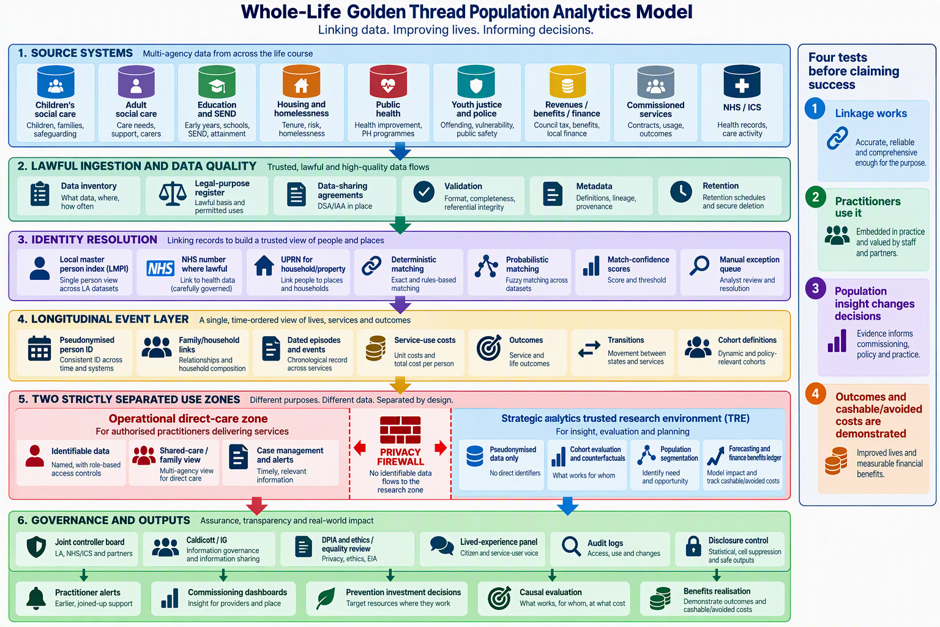
Figure 1: A practical whole-council architecture for turning fragmented service records into a governed longitudinal person, family and household view while keeping identifiable direct-care access separate from pseudonymised strategic analytics.
Information governance: lawful, proportionate and intelligible
There is no universal “golden thread legal basis”. Each purpose and data flow requires assessment.
For normal personal data, councils may often consider Article 6(1)(e), public task, where processing is necessary for a statutory function. Special-category information additionally requires an Article 9 condition; health and social-care management may engage Article 9(2)(h), public health Article 9(2)(i), and properly safeguarded research or statistics Article 9(2)(j). Criminal-offence data brings additional DPA 2018 requirements.
UK GDPR compliance does not automatically satisfy the common-law duty of confidentiality. Direct-care sharing, secondary analysis and research must be distinguished. Greater Manchester’s framework shows this in practice: identifiable shared-care access, pseudonymised analytics, section 251 support for specified secondary uses, separate DPIAs, role-based access and opt-out arrangements.
Every programme should have:
a documented purpose and data-flow map;
DPIA, data-sharing or joint-controller agreement;
Article 6 and Article 9 reasoning;
minimisation, retention and deletion schedules;
role-based access, audit logs and regular entitlement reviews;
separation of identifiers and analytical attributes;
disclosure control for outputs;
transparent privacy information;
equality, ethics and algorithmic-impact review;
lived-experience participation.
Pseudonymisation reduces risk but does not normally take data outside data-protection law. The ICO’s code emphasises fairness, safety, transparency and organisational not merely technical conditions for trusted sharing.
Turning prevention into an invest-to-save proposition
The most credible model is a prospective evaluation and benefits contract, not a retrospective claim that every improved outcome represents a saving.
The financial method
For each intervention:
Define eligibility before delivery.
Establish a historical and contemporaneous baseline.
Create the strongest feasible comparator: randomisation, stepped-wedge rollout, matched comparison, regression discontinuity or difference-in-differences.
Track the same cohort through education, care, health, housing and justice.
Pre-register primary outcomes and avoid selecting only favourable measures.
Apply transparent unit costs.
Discount future benefits and conduct sensitivity analysis.
Report attribution, deadweight, displacement and optimism bias.
Reconcile modelled benefits with finance-led budget evidence.
Benefits should be categorised separately:
Cashable: an expenditure line genuinely reduces.
Avoided cost: future demand does not occur, but no budget is immediately released.
Productivity: practitioners save time or process more efficiently.
Fiscal transfer: one organisation invests while another benefits.
Economic or social value: improved wellbeing, employment or life chances.
Greater Manchester’s CBA model is useful because it distinguishes fiscal, economic and social value, identifies who pays and who benefits, and includes payback periods and cashability. Its accompanying unit-cost database spans crime, education, employment, health, housing and social services.

Bridging organisational budgets
Section 75 of the NHS Act 2006 allows NHS bodies and councils to contribute to a common fund for health or social-care-related services and is the statutory basis for Better Care Fund pooling. It can support integrated neighbourhood, discharge, reablement and prevention services, but it is not a universal mechanism for pooling every children’s, housing, police or justice budget.
For broader golden-thread investment, places can use:
aligned rather than formally pooled budgets;
a jointly governed prevention fund;
combined-authority or integrated-settlement flexibilities;
gain-sharing agreements based on verified benefits;
contributions weighted by expected beneficiary;
staged funding released against evidence milestones;
a cross-partner outcomes framework and benefits ledger.
The governing principle should be: the organisation that pays for prevention should not carry all the risk when savings accrue elsewhere.
Models England can realistically learn from
Wales: SAIL and the emerging CARE Lab
SAIL combines long-running, de-identified population data in a trusted research environment with independent governance. Wales is now adding adult social-care records through the Social Care Linked Data Lab, linking the Adults Receiving Care and Support census with health, census and children’s social-care data. The project explicitly asks which children transition into adult services and which do not.
Its transferable lesson is institutional: a durable national TRE, repeatable approvals, a linkage service, stable stewardship and lived-experience involvement. English councils could approximate this regionally through ICS secure data environments rather than each council building an isolated research platform.
Scotland: a longitudinal care asset, not annual snapshots
Scotland’s Looked After Children Longitudinal Dataset joins annual returns from 2008/09 to 2023/24, covering around 72,000 children, 85,000 care episodes and 179,000 placements. Subject to approval, it can be linked to education, health and justice data in the Scottish National Safe Haven.
The National Safe Haven provides a governed TRE, accredited-researcher access, trusted third-party indexing and a Five Safes-based route to approval. This combination of standardised national collections, a population spine and enduring safe infrastructure is more important than any particular software product.
New Zealand: the Integrated Data Infrastructure
New Zealand’s IDI brings together de-identified person and household information across health, education, benefits, income, employment, housing, justice and migration. Identifiers are used for linkage before being removed or encrypted, and outputs are checked before release.
The transferable lesson is its population spine and investment discipline: cross-sector data is treated as research infrastructure for understanding long-term outcomes, not as an unrestricted operational surveillance system. England could adopt the spine-and-TRE concept regionally while retaining UK legal, local-democratic and NHS governance.

Why good programmes stall
Common failure modes are remarkably consistent:
building a platform before agreeing priority questions;
treating IG as a late-stage approval exercise;
weak identifiers and no ownership of source-data quality;
attempting national-scale linkage before proving a priority cohort;
dashboards that practitioners do not use;
predictive models without an intervention pathway;
benefits owned by analysts rather than finance;
relying on short-term transformation funding;
no public or lived-experience oversight;
claiming gross avoided costs as cashable savings;
leadership turnover and unresolved partner incentives;
failing to maintain data pipelines, metadata and permissions.
Essex’s experience is instructive: its discovery work exposed data-quality, legislative and operational limitations early enough to reframe the project, while its partnership model combined senior sponsorship, analytical capability and independent ethics arrangements.
A realistic roadmap for an English council
Stage 1 Purpose, inventory and legal mapping
Select two or three questions: for example, reunification sustainability, care-leaver housing stability or transition from SEND to adult support. Map datasets, identifiers, quality, statutory purpose, controllers and retention.
Stage 2 Identity and household foundations
Create a master person index; adopt UPRN consistently; quantify match quality; establish family and household relationships as time-bound rather than permanent assumptions.
Stage 3 Priority cohort linkage
Build a pseudonymised longitudinal event dataset for one cohort. Include pre-intervention history, outcomes, service costs and comparison candidates. Do not begin with predictive risk scoring.
Stage 4 Operational and analytical products
Develop a tightly controlled practitioner view only where necessary for direct care. Separately create population dashboards, cohort evaluation and a finance benefits ledger.
Stage 5 Independent evaluation
Agree the counterfactual before scaling. Publish the theory of change, outcome definitions, limitations and distributional impacts. Finance should validate cashability.
Stage 6 Cross-partner expansion
Add NHS/ICS, police, justice, DWP or commissioned-provider data only where this materially improves the question. Use a TRE and formal data-access committee for secondary analysis.
Stage 7 Institutionalise
Move from project funding to a multi-year data-and-evaluation function sponsored jointly by the chief executive, DCS, DASS, director of public health, housing, finance, digital/data leadership and ICS partners.
Conclusion: Data as Shared Prevention Infrastructure
The golden thread is not a database and it is not a prediction about an individual child. It is a public-service capability: the ability to follow patterns across time, test whether prevention worked, recognise where transitions failed and see when one organisation’s investment benefited another.
Supporting Families proves that linked national data can support credible cross-sector impact analysis. Family Safeguarding shows that whole-family operating models can reduce acute demand and generate plausible avoided costs. Bristol demonstrates practitioner use. Bradford, Kent, Barking and Dagenham and Greater Manchester demonstrate population-scale linkage. BOLD reveals the blind spots between housing and justice. Wales, Scotland and New Zealand show what durable longitudinal infrastructure looks like.
The evidence does not yet justify claiming that better childhood prevention will automatically produce quantified adult-social-care savings decades later. It justifies something more disciplined: investing in the analytical, governance and evaluation infrastructure required to find out and using that evidence to shift resources towards the interventions that genuinely change lives.


