

Cultures created by Leadership Teams and Groups
THE VALUES OF THE LEADERSHIP GROUP
Through our work, we have found that the level of consciousness of the leadership group is a significant factor in diagnosing the cultural issues of an organisation. Based on the thousands of surveys we have carried out, we have been able to develop some relatively hard and fast rules about organisational cultures and leadership groups.
Rule 1: An organisation cannot operate at a higher level of consciousness than the personal consciousness of the leadership group.
Rule 2: The culture of an organisation is either a reflection of the personal consciousness of the leadership group (conscious or subconscious) or is inherited from previous leadership groups.
Rule 3: In general, most organisations operate with a “default” culture because it arises unconsciously. The culture is not managed; the culture is not monitored; and the culture is simply recognised as “the way things are done around here.”

In such situations, when the leadership group first sees the results of their Cultural Values Assessment (CVA), they are shocked to find that the culture they administer is lower than their personal consciousness. They have fallen into the trap of accepting “this is the way things are done around here.” They are not conscious of what they have created, and they are unskilled at creating the culture they want to experience. Furthermore, they do not realise that by changing their collective behaviours they can change the culture. Our research has shown that the cultures created by leadership groups can be categorised into five basic types, characterised by the distribution of the Cultural Entropy® score across hierarchical levels of the organisation.
SHADOW CULTURE
The shadow culture is typified by a high level of cultural entropy in the leadership group that gradually decreases as move down the hierarchical levels. The dysfunction of the personalities of the leadership group casts a shadow across the organisation; the further away from the leadership group you get, the less impact the shadow has on the work culture.

DENIAL CULTURE
The denial culture is typified by a low level of the Cultural Entropy score in the leadership group that rises sharply at the next level and then decreases gradually toward the lower echelons of the hierarchy. The leadership group lives in their own world, unaware or impervious to the chaos they have created around them. They live in denial of the culture they have created. The direct reports of the leadership group have to deal with the dysfunction caused by their bosses.
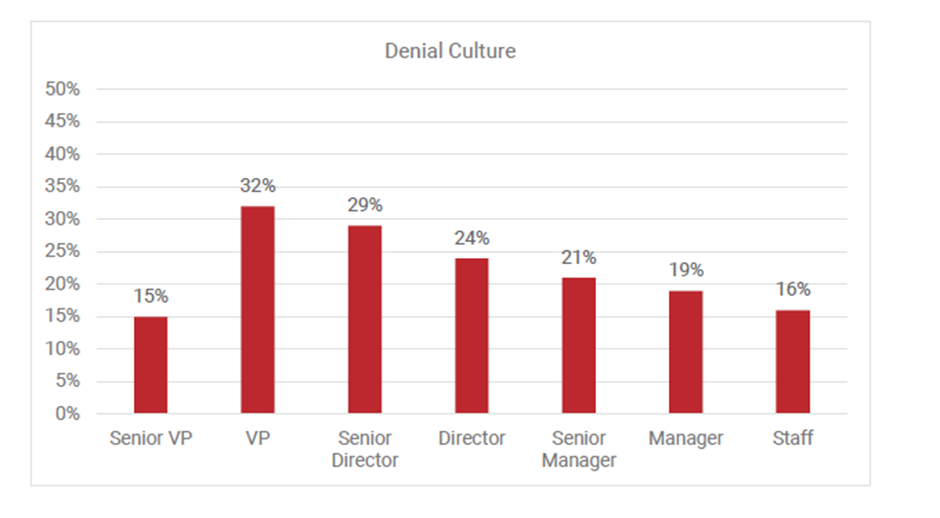
SQUEEZE CULTURE
The squeeze culture is typified by a low or medium level of the Cultural Entropy score in the leadership group that gradually increases towards the middle management levels and then gradually decreases towards the lower echelons of the hierarchy. The dysfunction occurs at the middle-management levels, not because of dysfunction from above, as in the denial culture, but because of the delegated accountability for producing results being pushed down the managerial level. The middle managers come under intense pressure from above to produce results and from below to make decisions. This type of culture arises when managers are given accountability without authority.

CRISIS CULTURE
The crisis culture is typified by a pervasive high level of the Cultural Entropy score throughout all levels of the organisation. This type of culture is often found in the public sector, where there are strong bureaucratic tendencies and rigid hierarchies. Part of the problem is that the leaders feel powerless to change the culture because of political interference and/ or strong unionisation. Our experience suggests that both the political masters and the union bosses will willingly collaborate when they understand the purpose of cultural transformation and can appreciate the change in climate and performance that will flow from a culture-change project. Both groups need to be brought on board at an early stage in the process, by sharing with them the compelling reasons for change.
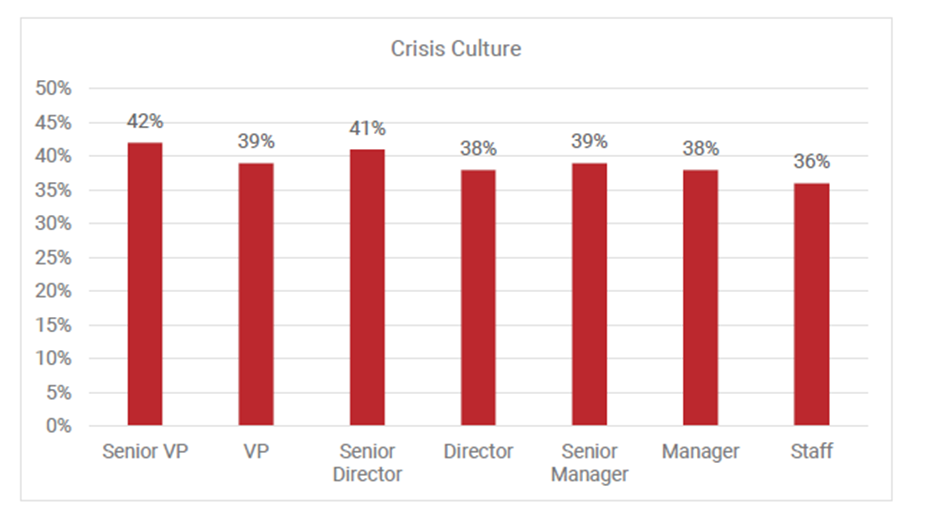
VALUES-DRIVEN CULTURE
The values-driven culture is typified by a low level of the Cultural Entropy score throughout all levels of the organisation. Values-driven cultures are products of a values- management process and/or the result of inspired leadership and are the highest performing cultures. Values-driven cultures are typically consciously created: The leader and the leadership team choose the values of the organisation and actively live them. They reinforce the values by constantly referring to them and make them part of every organisational system and process. They sustain a high-performing culture by regularly mapping the culture and the individual performance of every executive and manager. Promotions are not based on performance results alone, but on the executive’s or manager’s ability to live the values.

CONCLUSION
We can classify the first four of these cultures as “default” cultures because they arise unconsciously. They are an expression of the personalities of the past and present leaders of the organisation. No one has consciously attempted to manage the culture of the organisation and there has been no attempt at values management. Conversely, the fifth type of culture is values-driven. In such cultures, the leadership group consciously creates the culture they want to experience and actively manages their cultural capital. To this end, in addition to monitoring their own personal entropy, they remove the influence of previous leadership groups on the culture by carrying out structural realignment. This involves making sure that the values the leadership team want to see in the culture are fully integrated into the organisation’s systems, policies and procedures. The desired values should be reflected in the incentives.

By Richard Barrett, Founder of Barrett Values Centre®


