Understanding the Disconnect: National Strategy vs Local Delivery
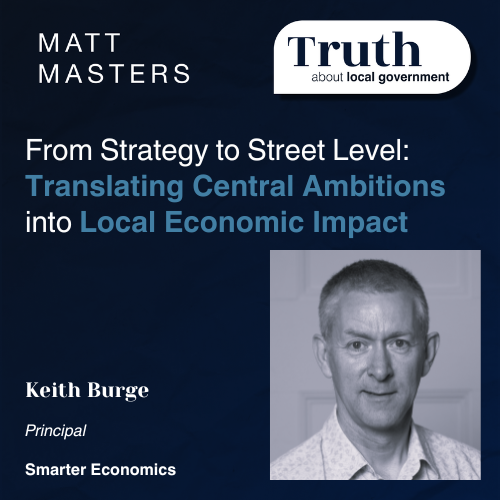
One of the most persistent and often overlooked challenges in local economic development is the assumption that national strategies can be universally applied across all regions. It’s a seductive idea after all, national frameworks are designed to drive growth, innovation, and prosperity. But as Keith Burge pointed out in our conversation, this assumption rarely holds true in practice.
National strategies, such as the recently launched modern industrial strategy, are crafted with the broader national interest in mind. They aim to stimulate growth in key sectors, attract investment, and position the UK competitively on the global stage. However, these ambitions don’t always reflect the nuanced realities of every town, city, or region. The economic makeup of a post-industrial northern town is vastly different from that of a tech-driven urban centre in the South East. Trying to apply the same strategic blueprint to both is not only ineffective it can be counterproductive.
“If you're an underperforming part of the country, crikey, if you had those eight sectors in any numbers in your area, you wouldn't be underperforming.”
Keith’s observation is a stark reminder that economic underperformance is often rooted in structural challenges that national strategies may not be equipped to address. For local authorities, the temptation to retrofit their strategies to align with national frameworks is understandable especially when funding is tied to those priorities. But doing so can lead to misaligned interventions, wasted resources, and missed opportunities.
Instead, Keith advocates for a more selective and pragmatic approach. Local authorities should engage with national priorities where there is genuine alignment, but they must also be bold enough to chart their own course. This means developing strategies that are grounded in local data, shaped by community needs, and focused on the assets and opportunities unique to each place. Local relevance must take precedence. Whether it’s a focus on heritage-led regeneration, green infrastructure, or community enterprise, the most effective strategies are those that reflect the lived experience of local people and the economic realities of their area. National ambition is important but it must be translated through a local lens.

Crafting Bids That Stand Out
In the world of public funding, competition is fierce and resources are finite. Keith’s extensive experience in appraising funding bids for combined authorities across the UK has given him a clear view of what separates a winning bid from a weak one. And the difference, he says, is often obvious from the outset.
“You can tell a mile off when somebody has just pulled something out of the bottom drawer.”
Too many bids are recycled from previous applications, hastily adapted to fit the latest funding opportunity. This approach not only lacks originality it often fails to demonstrate a clear understanding of the funder’s priorities. A strong bid, by contrast, is bespoke. It is tailored to the specific objectives of the funding programme and backed by robust evidence.
Keith emphasises the importance of focus. A bid doesn’t need to tick every box it needs to tick the right ones. Trying to claim that a single project will solve multiple complex issues can dilute its impact and credibility. Instead, applicants should concentrate on what their project does best and articulate that clearly. Specificity is key. Vague promises about “improving employability” or “boosting local growth” won’t cut it. Funders want to see how, for whom, and to what extent these outcomes will be achieved. What demographic is being targeted? What barriers are being addressed? What measurable change will result?
A compelling bid is one that tells a coherent story one that connects the project’s activities to the funder’s strategic goals, supported by data, local insight, and a clear delivery plan. It’s not just about asking for money; it’s about demonstrating value.

Strategic Alignment: A Practical Approach
Aligning a project with the strategic objectives of a combined authority or funding body should, in theory, be a straightforward exercise. Most strategies are published and publicly accessible, offering a clear roadmap of priorities, outcomes, and desired impacts. Yet, as Keith noted, many bids fail to make this connection explicit.
“Pick out the exact ambitions listed in the documentation and show how your project contributes.”
This is more than a box-ticking exercise. It’s about demonstrating that the project has been designed with the strategic context in mind. Applicants should reference specific goals whether it’s reducing economic inactivity, improving digital infrastructure, or enhancing environmental sustainability and explain how their project will contribute.
This level of alignment not only strengthens the bid but also builds trust. It shows that the applicant understands the strategic landscape and is committed to delivering outcomes that matter to the funder. It also helps evaluators compare bids more effectively, ensuring that resources are allocated to projects with the greatest potential for impact.

Retrofitting Strategies: A Messy Reality
With the launch of new national strategies such as the modern industrial strategy many combined authorities are now revisiting their local economic plans. The intention is clear: to align with central government priorities and unlock access to funding and support. But as Keith Burge aptly described, the process is rarely straightforward.
“In an ideal world, strategies would fit together like Russian dolls. The reality is much messier.”
This analogy captures the frustration many local leaders feel. Rather than a seamless nesting of national, regional, and local strategies, the reality often resembles a chaotic attempt to force mismatched pieces together. Strategies developed in isolation, or under different political and economic conditions, may no longer reflect current priorities or opportunities. Keith argues that local strategies should not be static documents gathering dust on a shelf. Instead, they should be living frameworks regularly reviewed, refined, and revalidated. He suggests annual reviews as a minimum standard, allowing authorities to respond to shifting economic conditions, policy changes, and emerging local needs.
This approach requires a cultural shift. Too often, strategies are treated as long-term commitments, locked in for five or even ten years. But as recent years have shown from the pandemic to inflationary pressures and technological disruption economic landscapes can change rapidly. Local authorities must be agile, willing to adapt, and unafraid to challenge outdated assumptions. Retrofitting strategies isn’t just about compliance it’s about relevance. It’s about ensuring that local plans remain fit for purpose and capable of delivering real impact in a dynamic environment.

The Rise of Neighbourhood-Based Approaches
One of the most encouraging trends Keith identified is the renewed focus on neighbourhood-level interventions. This marks a return to the principles of area-based regeneration seen in the early 2000s, when programmes like Sure Start, New Deal for Communities, and Housing Market Renewal Pathfinders placed communities at the heart of economic development.
Today, we’re seeing a resurgence of this thinking through initiatives such as local health hubs, employability centres, and the rebadged long-term plan for towns now reframed as a plan for neighbourhoods. These programmes recognise that meaningful change often starts at the hyper-local level, where services are most accessible and responsive to community needs.
“There’s a danger of confusion and missed opportunities if these initiatives aren’t integrated.”
Keith’s warning is timely. While the proliferation of neighbourhood-based schemes is welcome, there is a risk of fragmentation. Without strategic oversight, overlapping agendas such as health, employment, education, and housing can lead to duplication, inefficiency, and confusion for service users. The solution lies in integration. Local authorities must take a joined-up approach, aligning neighbourhood initiatives with broader strategic goals and ensuring that services complement rather than compete. This requires collaboration across departments, sectors, and agencies, as well as a shared commitment to place-based working.
Neighbourhoods are not just administrative units they are lived spaces, shaped by relationships, histories, and identities. By investing in them thoughtfully and strategically, local authorities can unlock powerful levers for economic, social, and environmental transformation.

Reframing Economic Development as Investment
Perhaps the most provocative insight from Keith was his call to reframe economic development not as a cost, but as an investment. This is a fundamental shift in mindset one that could have profound implications for how local authorities prioritise and resource their work.
“It’s a constant frustration that economic development isn’t a statutory function. It should be.”
In recent years, austerity and funding pressures have forced councils to focus on statutory services those legally required, such as social care, housing, and education. Economic development, by contrast, is discretionary. As a result, it is often underfunded, understaffed, or sidelined altogether.
Yet economic development is the engine that drives local prosperity. It creates jobs, attracts investment, boosts tax revenues, and reduces demand on public services. When done well, it pays for itself many times over. Keith argues that central government must recognise this and provide the resources and policy frameworks to support it.
This means treating economic development as a long-term investment, not a short-term expense. It means funding local authorities to build capacity, develop strategies, and deliver programmes that generate real value. And it means embedding economic development into the core functions of local government, with the same status and support as other statutory services. Only then can local authorities fully realise their potential as drivers of inclusive, sustainable growth.

Final Thoughts: Be Ambitious, Be Authentic
As our conversation drew to a close, Keith offered a message of cautious optimism. Despite the challenges, he sees a growing appetite for change a renewed commitment to place-based working, evidence-led strategy, and meaningful local impact.
“Not everywhere is going to be the next centre of the universe for AI. Be ambitious, but be realistic.”
This advice is both pragmatic and empowering. It reminds us that every place has its own story, its own strengths, and its own potential. The goal is not to mimic national trends or chase the latest buzzwords, but to build strategies that are authentic, grounded, and achievable. Local authorities must be bold in their vision, but honest in their assessment. They must use data to inform decisions, engage communities in shaping priorities, and focus on what works for their area not what looks good on paper. Economic development is not a one-size-fits-all endeavour. It is a craft, shaped by context, collaboration, and care. And as Keith reminded us, the most successful places are those that know who they are, where they’re going, and how to get there.
Conclusion: Strategy That Works for People and Place
Translating central ambitions into local impact is no easy feat. It requires strategic thinking, rigorous evidence, and a deep understanding of place. As Keith Burge reminded us, success lies not in chasing national trends, but in crafting authentic, locally grounded strategies that reflect the true character and potential of our communities.
Whether you're a Director of Place, a policy officer, or a community leader, the message is clear: be bold, be specific, and above all, be local.